It was August in Seville, and I was twenty-two years old, drunk on cheap wine and the certainty that I knew everything.
My grandfather had given me his old leather coat before I left Milan, a coat he had worn, he said, “before the war made all our clothes into uniforms.” He told me to go to Spain. He told me to find what made his blood run hot when he was my age. He told me, mostly, to keep my mouth shut and watch.
So I sat in the cheapest seat at the Plaza de Toros de la Maestranza, and I waited.
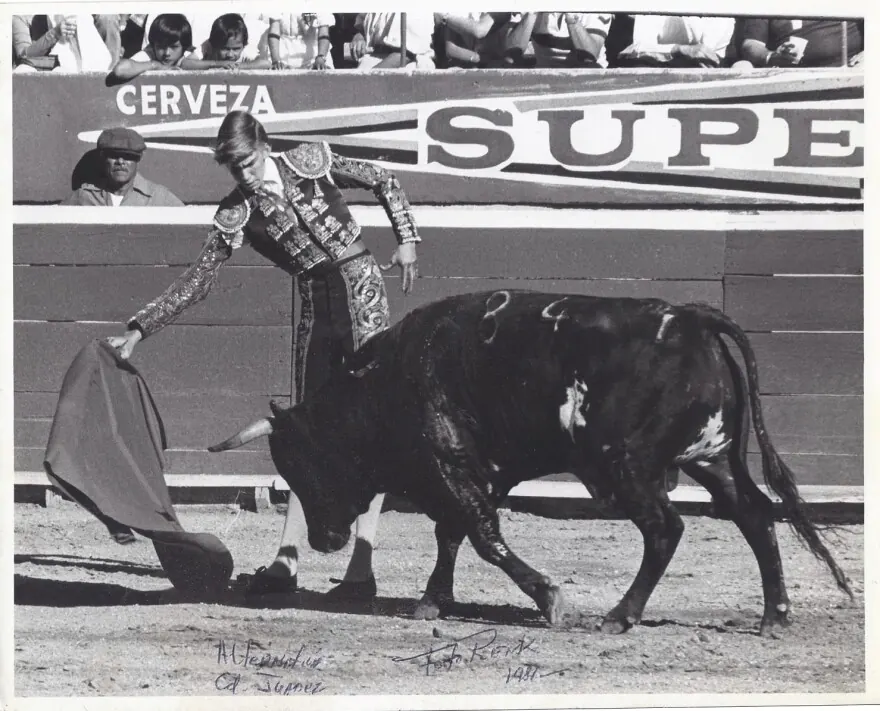
I had come, I thought, for spectacle. For something to write home about. I expected violence, and there was violence. I expected color, and there was color. The sand was raked into perfect golden circles. The afternoon sun fell at a slant that made the matador’s suit of lights look like something pulled from a chapel, all silver and crimson and impossible thread.
But what I did not expect was the silence.
There is a moment in the corrida, one every Spaniard knows and every aficionado has felt, when the bull stops. He has run. He has charged. He has been wounded and provoked and turned in circles by a piece of cloth no bigger than a tablecloth. And then, for one breath, he stops. He looks at the man. He decides.
I saw two beings, suspended in a single second of recognition. And in that second, they were equals.
I went home to Milan. I tried to forget it. I failed.
I worked for a leather house in Como for six years, then for another in Florence. I learned to recognize a hide by smell. I learned which tanneries used oak bark and which used chemicals, and I learned to despise the latter. I learned that a buckle, properly weighted, will close itself. I learned, mostly, to be patient, which my grandfather had been trying to teach me my entire life, and which I only understood once I had a piece of leather in my hands and time enough to wait for it to soften.
And the whole time, I was thinking about the bull. Not the killing. The killing did not interest me. What interested me was the suspension, the held breath, the second before everything was decided. I wanted to make objects that lived inside that second. Objects that knew they were beautiful but did not need to prove it.
This is what Torero is. It is not a celebration of conquest. It is a study of poise. The horns in our mark are not weapons. They are the curve of a thing about to happen. The script that crosses them is the cape, the flourish, the half-second of grace that makes the difference between a man and a man who has chosen.
My grandfather died the spring I founded the house. He never saw the first piece. But he is in everything we make: in the patience, in the silence, in the coat I still wear most weekends, which has now lived three lives and is somehow more beautiful in this one than the last.
Every piece we make is an attempt to bottle that decision. I hope you find it useful.